Because IBS isn’t solved in appointments. It’s solved in the moments between them. Powered by Adaptive AI—Physician Supervised.


We Don’tJust Calm Symptoms. We Unlock What IBS Forced You to Restrict.
Not as concepts—as a coordinated, physician-guided system designed to work together.
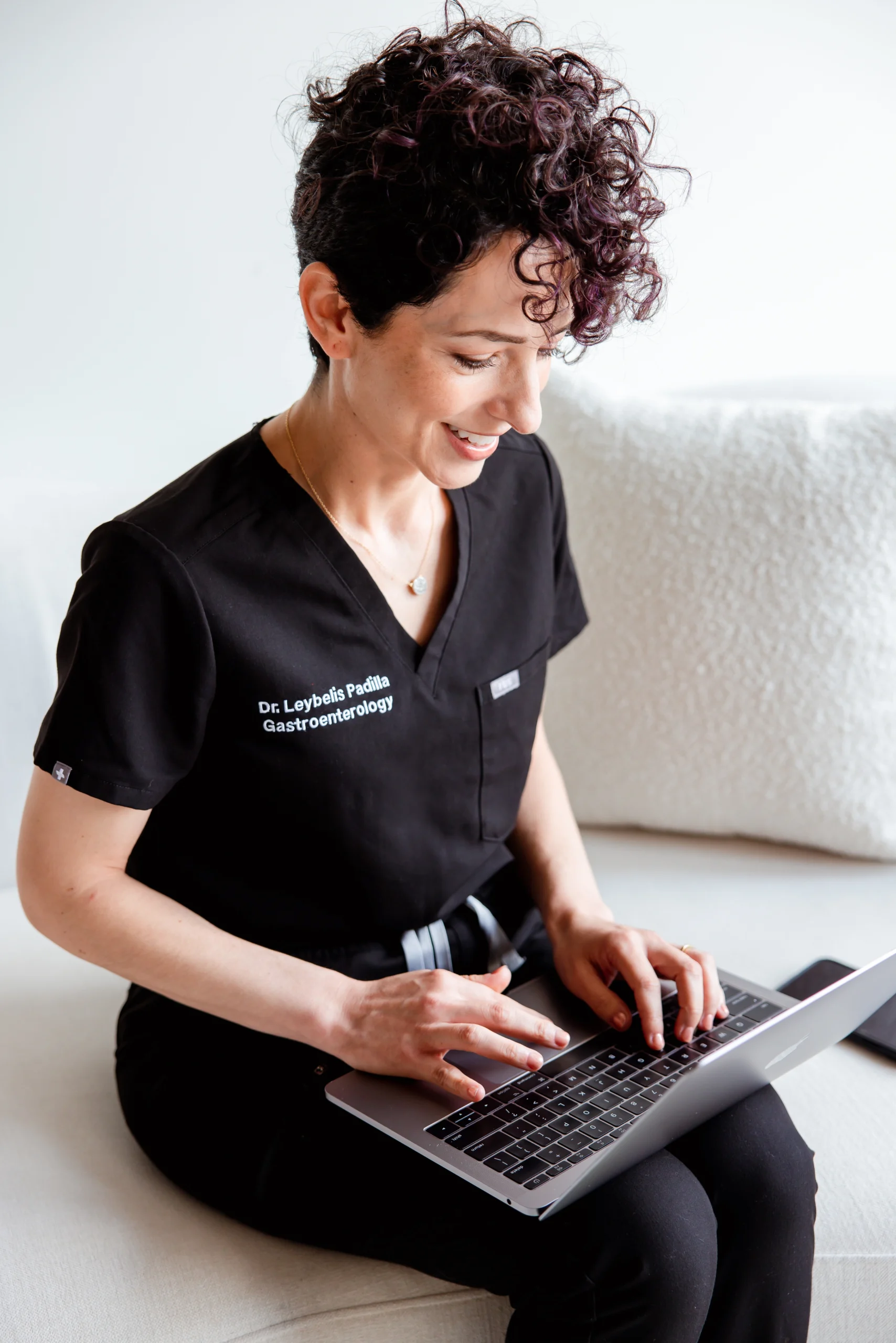
Dr. Leybelis believes the current healthcare system often treats digestive symptoms in isolation, leaving important gaps in care.
Because in IBS, the mind-gut connection isn't optional - it's foundational.
Our mindset pillar draws from research in neuroplasticity, heart rate variability (HRV), and heart coherence principles. Dr. Leybelis participated in the Inner Health Coalition, a network of medical professionals exploring the integration of meditation and mindfulness tools by the work of Dr. Joe Dispenza into conventional healthcare.
These tools are incorporated thoughtfully and alongside evidence based medical care.
As a registered dietitian, I’ve spent years supporting individuals who want to feel better in their bodies but are often overwhelmed by conflicting nutrition advice and one-size-fits-all wellness trends.
I began to see a clear pattern: gut health and long-term wellbeing are rarely shaped by just one food or one habit. Digestive function, dietary patterns, metabolic health, and daily lifestyle choices all influence how people feel—but these pieces are often addressed in isolation.
Through my clinical work, education, and experience in corporate wellbeing, I began to build an approach centered on practical, evidence-based nutrition that is both inclusive and sustainable.
My goal is to help people move beyond confusion and restriction toward a clearer, more supportive path to digestive health and overall wellbeing.
Because IBS isn’t solved in appointments. It’s solved in the moments between them. Powered by Adaptive AI—Physician Supervised.
Get access to the app and get:
As you provide feedback:

We map your symptoms, history, triggers, and patterns in detail. We obtain baseline blood work and stool testing.
You receive a structured, physician-guided plan across all four domains.
Your plan evolves based on your responses—not a fixed schedule.
We refine until your symptoms stabilize—and your life expands again.
*30 day refund guarantee
FOR PATIENTS LOCATED IN CALIFORNIA AND IDAHO ONLY
Remember those surprise bills in the mail even though insurance told you it was “covered”? That’s why we don’t do insurance.
Because sustainable IBS improvement requires:
Quick fixes often fail because they skip the nervous
system and habit layers
No.
Over-restriction often worsens sensitivity.
We focus on:
The goal is expansion – not shrinking your world.
Traditional GI visits are often time-limited and focused on ruling out danger. We are augmenting your existing gastroenterology care. It’s not meant to replace it.
This program is designed to:
IBS is rarely fixed in weeks.
Most patients notice:
IBS improvement looks like:
Someone who:
$1,999 paid annually. If you aren’t happy with your experience, receive a full refund if requested within 30 days of signing up. Email hello@leybelismd.com
Because this program includes physician-led medical care, patients must reside in California and Idaho for us to provide clinical services. If you live outside of California or Idaho, we hope to expand in the future and encourage you to stay connected for updates.
This is included in your annual fee. A $500 value alone!
We will do baseline blood work and stool testing to include looking at your liver enzymes, kidneys, electrolytes, thyroid, blood counts (looking for anemia), and screening for celiac disease. We will also check stool for markers of inflammation. For a detailed list of testing, please reach out to us for specific questions at hello@leybelismd.com


Featured in the New York Post, Dr. Leybelis Padilla shares a practical colonoscopy “behind-the-scenes” tip—prep isn’t always perfect, so plan to head home and reset after the procedure—while reinforcing that screening helps prevent colorectal cancer.

Millions have cut out bread thinking gluten is the culprit—but a recent Fox News report featuring Dr. Leybelis Padilla explains that for many people, symptoms may be driven more by other factors.

Your gut thrives on balance—not overload. In Parade, Dr. Leybelis breaks down why processed meats can be tough on digestion, describing how they can “stress” the gut ecosystem by fueling inflammation.

In a Newsweek feature, Dr. Leybelis Padilla shares three practical, natural ways to support gut health—focusing on fiber-forward eating, stress regulation (rest-and-digest tools like breathing/meditation), and movement as a daily “gut tune-up.”

It’s easy to feel lost in the vast wilderness that is stomach—or more accurately, abdominal—pain. But doctors have learned to read our midsection like a map. As they say, it’s all about location, location, location.
It’s not just your family history of colon cancer that matters when it comes to deciding when you should be getting a screening colonoscopy.
Did you know that your family history of colon polyps matters. And by family history, I mean your first degree relatives, “aka” your siblings and/or parents. And it can matter a lot.
Polyps are not created equal as there are different kinds of polyps. Some of which are considered entirely benign, meaning they don’t carry a risk of potentially turning into colon cancer. And then, there are other kinds of polyps that are considered precancerous, meaning they do carry a risk of potentially turning into colon cancer over time.
Knowing your family history of polyps is important because it’s all in the details and knowing these details may mean you need a colonoscopy much earlier than you might have thought.
If your parents and/or siblings have had a colonoscopy and polyps were removed, you want to ask them the following information:
Can I get a copy of the colonoscopy and pathology report? I will be honest with you, the way our healthcare system is, it’s tough to do this. But if you can, awesome. Otherwise, here are some questions to ask:
– How many polyps were removed?
– What size were they?
– Do you know what kind of polyp was removed?
The reason this matters is that if your family member had an “advanced adenoma/polyp” removed before age 60 OR if you have more than 2 family members at any age with an “advanced adenoma/polyp” history then:
You should get a colonoscopy at age 40 OR 10 years before your youngest affected relative, whichever is earlier. You are then committed to future colonoscopies of at least every 5 years.
Now, the obvious question is what exactly is an “advanced adenoma/polyp”?! This is a polyp we define as one of the following:
Any one of these features on your family member’s colonoscopy, means you should be getting a colonoscopy likely earlier than the general age 45 screening recommendation.
Now, if you don’t have a way to get your family records or history, don’t panic. Chances are that by not putting off your routine, screening colonoscopy at age 45 will be just fine!
Talk with your doctor if you have questions or concerns and at least begin the conversation. And I will be honest with you. There are SO many things your primary care doctor has to keep track of that your primary care doctor might not know the information I just mentioned. If they don’t, that’s ok! They really aren’t expected to know this kind of stuff. But they can refer you to a Gastroenterologist to continue the conversation and that’s what matters.